The virtual heart
spiral waves simulation numerical ventricular fibrillation atrial
fibrillation ventrciular tachycardia java excitable media movies excitable
media Fitzhug nagumo beeler reuter luo rudy model mathematical cell modeling
3d heart virtual arrhythmias ventricular fibrillation tachycardia excitable media mathematical cardiac modeling real heart spiral wave breakup
3D realistic mathematical modeling of cardiac dynamics and arrhythmias in anatomically correct hearts
The "Cardiac Virtual Museum", includes various galleries you can tour like: the human atria and the dog ventrcles exhibits
This page contains VRML's of various heart structures. To see them, you need to install a VRML viewer in your browser (unless you have one already), we recomend to use
Cortona VRML client (Free and available for Windows and Mac), which is quick and very easy to install and can be also used for powerpoint presentations.
This page contains examples of X3D's files
In this section you can find various movies about heart dynamics, both experimental and numerical.
Use the tabs above to go to the experimental or numerical movies sections
Contracting ventricular cell
In this section you will find experimental movies from single cells to tissue.
Intracellular calcium waves shown using fluo-4 dye and a confocal microscopy
Propagating calcium wave producing
the contraction of a ventricular cell
Multiple calcium sparks
Optical mapping (Tissue)
Voltage in the tissue is displayed as a function of color
using di4-ANEPPS voltage dye and high speed cameras.
Spiral wave (Reentry)
of electrical activity
Spiral wave breakup
more complex activity
Spiral wave breakup produced by a meandering tip trajectory that causes Doppler shift
Visualization of a 3D scroll wave by following the spiral tips on all planes to form a vortex filament, whose curvature, twist, and torsion can be measured. This movie shows how the vortex filament is obtained at a fixed time by showing the spiral at different depths through tissue. The filament color indicates the local twist.
Breakup of a 3D scroll wave by patchy failure due to discrete effects (coarse spatial resolution). Nine evenly spaced parallel layers from the epicardium to the endocardium are shown.
During normal rhythm, the heart beats regularly, producing a single coordinated electrical wave that can be seen as a normal electrocardiogram (ECG). During arrhythmias such as ventricular tachycardia and ventricular fibrillation, this normal behavior is disrupted and the ECG records rapid rates with increased complexity.
The underlying cause of many arrhythmias is the development of a reentrant circuit of electrical activity that repetitively stimulates the heart and produces contractions at a rapid rate. During tachycardia, a single wave can rotate as a spiral wave, producing fast rates and complexity. During fibrillation, a single spiral wave can degenerate into multiple waves. Because contraction is stimulated by the pattern of electrical waves, arrhythmias can compromise the heart's ability to pump blood and sometimes may be lethal.
To learn more about sinus rhythm and several kinds of arrhythmias, click on the tabs above. Each rhythm is demonstrated using a three-dimensional interactive simulation and a sample ECG, and
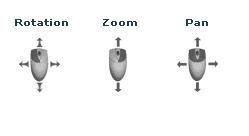
The contracting three-dimensional heart on the left can be rotated, zoomed, and panned by clicking and moving the mouse as indicated.
Heart : A powerful muscle slightly larger than a clenched fist. It is composed of four chambers, two upper (the atria) and two lower (the ventricles). It works as a pump to send oxygen-rich blood through all the parts of the body. A human heart beats an average of 100,000 times per day. In that time, it pumps more than 4,300 gallons of blood throughout the entire body. The heart's cycle starts when oxygen-poor blood from the body flows into the right atrium. Next the blood flows through the right atrium into the right ventricle, which serves as a pump that sends the blood to the lungs. Within the lungs, the blood releases waste gases and picks up oxygen. This newly oxygen-rich blood returns from the lungs to the left atrium. Then the blood flows through the left atrium into the left ventricle. Finally, the left ventricle pumps the oxygen-rich blood to all parts of the body.
The human body has about 5.6 liters (6 quarts) of blood, all of which circulates through the body three times every minute.
MRI anatomy of the Dog heart
The three-dimensional horse and heart on the left can be rotated, zoomed, and panned by clicking and moving the mouse as indicated.
MRI anatomy of the Horse heart
The three-dimensional horse and heart on the left can be rotated, zoomed, and panned by clicking and moving the mouse as indicated
This site is mantained and developed by
Elizabeth Cherry and Flavio Fenton
A single electrical wave produced by the heart's natural pacemaker spreads throughout the heart and induces a contraction. These waves normally occur about once every 0.8s.
(b) A spiral wave of electrical activity generated in the heart with a period of about 0.2s can produce the fast oscillations characteristic of an arrhythmia called tachycardia, which often directly precedes the onset of fibrillation.
(c) Multiple spiral waves produced by the breakup of a spiral wave can lead to the fast irregular oscillations characteristic of fibrillation.
java applets for excitable media
java applets for complex systems
java applets heart dynamics
FitzHugh-Nagumo (FHN) model single cell
FitzHugh-Nagumo model in 2D, interactive Java applet
Hodgkin-Huxley model interactive Java applet
Interactive Java applets, Mathematical models cardiac cell dynamics, exitable media and complex systems
real 3D heart, interactive human heart, dog heart spiral waves scroll waves
atrial fibrillation information. Realistic 3D heart with atrial fibrillation
Ventricular fibrillation information. Realistic 3D heart with ventricular fibrillation
Goldman-Hodgkin-Katz Equation The applet calculates the transmembrane
potential using the Goldman-Hodgkin-Katz Equation. One can vary all the ionic consentrations and observe the effects on the membrane potential "yellow line",
separating intracelular medium (In) from extracellular medium (Out). The Value of the membrane potential as well as the Nernst potential for the respective ions is plotted in the graph.
This applet shows the generation of the AP for a cardiac cell. The time during the upstroke is done slower so one can visualize the rapid influx of Na ions.
Compare with the neuron action potential.
Movies about heart dynamics, both experimental and numerical. Spiral waves. 3D scroll waves. single cardiac cells drift spiral wave
This page contains the virtual museum (version 1) in 3D. To travel in it, you need to install a VRML viewer in your browser (unless you have one already), you can use Cortona VRML client (Free and available for Windows and Mac), which is very quick and easy to install and can be also used for powerpoint presentations.
This is a larger, modern and updated version form the museum 1.0, it takes a little bit longer to fully download compared to version 1.0.
We recomend that you visit version 1.0 before visiting version 2.0. The museum was selected as a Web3Dart in 2007 and displayed at the the 12th International Conference on 3D Web Technology,
April 15-18, 2007 University of Perugia, Umbria, Italy.
3D VRML
This page contains VRML's of various heart structures. To see them, you need to install a VRML viewer in your browser (unless you have one already), we recomend to use Cortona VRML client (Free and available for Windows and Mac), which is quick and very easy to install and can be also used for powerpoint presentations.
X3D is the next step in the evolution of VRML. For more information visit the Web 3D consortium. You'll need an X3d viewer like Flux, check the Web 3D consortium for a list of players.
This page contains examples of X3D's files.
Contracting Dog Ventricles with spiral wave this is the same animation for VT shown on the Cardiac Rhythms section. However this is not Java as in there, this is done using X3D.
Pulmonary vein reentry Simulated idealized pulmonary vein with mini-reentry, it will take a few seconds to fully load all the images for the animation.
If interested in more X3D files, let us know (see contact section) and we'll post more
3d
dog
Flavio Fenton Elizabeth Cherry FentonCherry
Heartsok
Horse heart frontpage
awards
cells
horse
horse with heart
java applets
links
movies
museum
museum2
articles pdf
rabbit MRI
sheep MRI
x3d 3d objects
spin heart